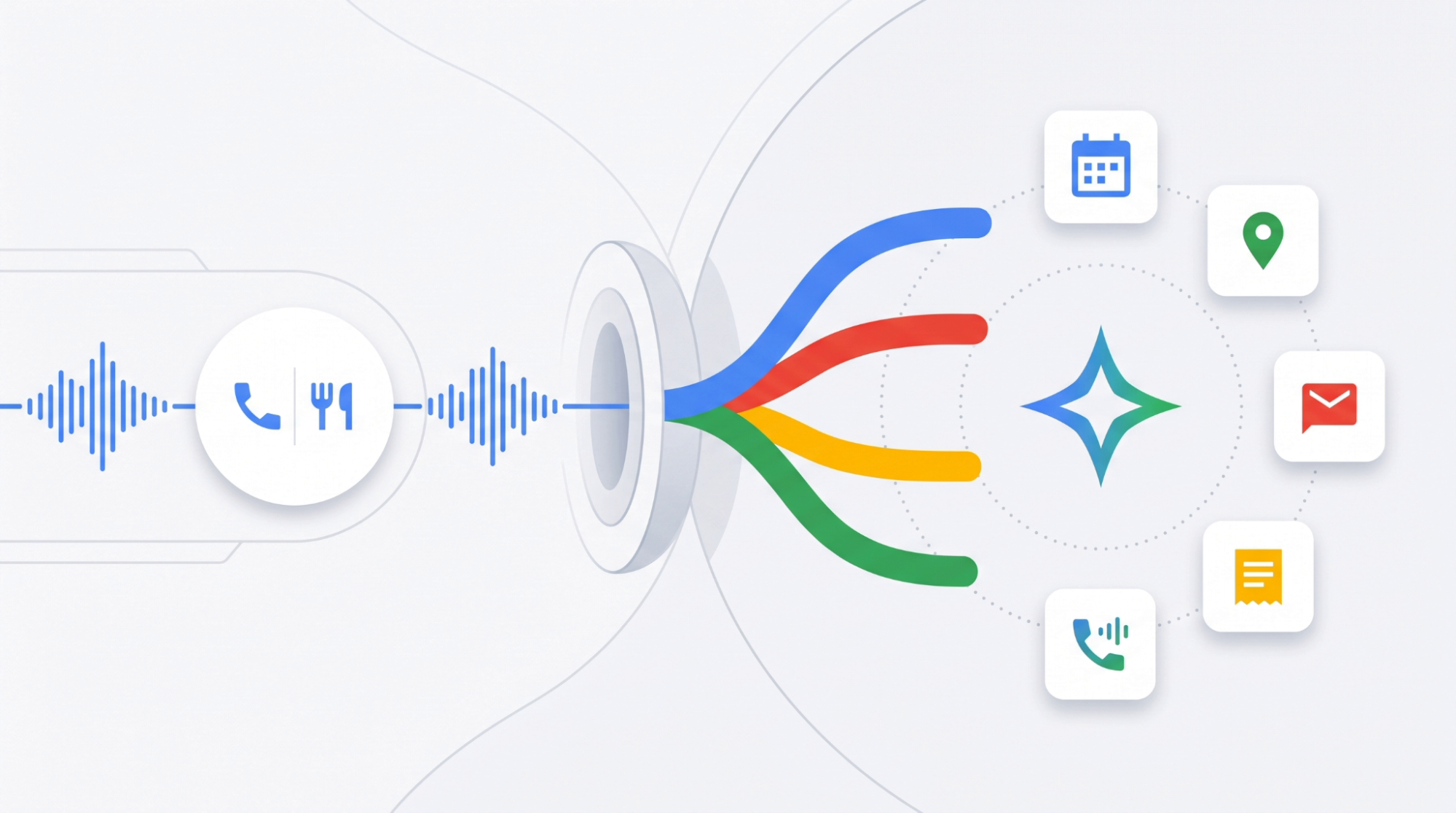

Google has published a technical account of how Duplex evolved into the calling stack used by Tasks in Gemini. The November 20 report describes a progression from narrowly trained phone systems through hybrid language-model pipelines to a stack built around Gemini.
This is an engineering explanation of the integration launched earlier that week, rather than a separate announcement that business calling has become available everywhere. Our earlier Tasks coverage addresses the product rollout; this report adds detail about the voice interaction behind it.
Phone calls are more than speech recognition
Google says the current stack unifies multimodal understanding, planning and dialogue generation, assisted by acoustic and conversational-cadence models. The system must handle noisy, compressed phone audio, interruptions and the timing of when to stop speaking.
Its earlier hybrid systems paired generative language with deterministic state tracking and policy controls. The current account describes free-text task descriptions replacing separate dialogue models for each narrowly defined task type.
Our analysis: success includes the other end of the line
A technically fluent exchange is only one part of completing a task. A business may decline a request, suggest an alternative or supply information that changes what the user should do next. A useful assistant needs to preserve that meaning rather than merely produce a natural-sounding reply.
Latency matters for the same reason. A pause or interruption is not only an audio artifact; it can change whether the other person thinks the call is continuing and whether an answer was understood. A meaningful evaluation would examine the conversation and its resulting action together.
Disclosure and business control are explicit design choices
The report says calls open by identifying the automated Google system. Businesses can opt out through Business Profile settings or request that calls stop during the conversation. Those are Google’s stated controls, not mechanisms we independently tested.
That distinction should remain visible when evaluating voice agents. A polished demonstration does not establish how an opt-out propagates, how ambiguous refusals are handled or whether every deployment has the same behavior. These are practical questions for a complete product assessment.
A technical account, not an independent reliability result
Google’s broader product description names Gemini 4 Hydrogen and Neon and other task modalities. The post does not supply an independent, standardized success rate for all phone tasks. We have not established account eligibility, geographic access or end-to-end performance through our own testing.
Our view is that the most useful lesson is the combination of language capability with conversation-specific engineering and clear boundaries for the people involved. We did not place a call, interact with a business, install software or change our own voice-model setup for this report.
Primary-source reporting and original editorial analysis. No installation, model inference, paid service call, security test or independent benchmark performed.